


Table of Contents
Why is text banking politics important? Communication is key in the fast-paced world of politics. In today’s digital age, harnessing technology is crucial to effectivFor modern campaigns, text banking politics helps teams reach voters quickly, personalize outreach, and drive action at scale. In the fast-paced world of political campaigning, communication isn’t just important – it’s everything.
And as attention spans shrink and traditional outreach methods lose their edge, campaigns need a channel that cuts through the noise and lands directly in voters’ hands.
Text banking does exactly that. It gives campaigns a direct, immediate line to thousands of supporters while still making each interaction feel personal. With the ability to mobilize grassroots support, engage in real-time conversations, and send tailored messages, text banking has become one of the most powerful tools in a modern campaign’s arsenal.
When is text banking important in politics?
Text banking plays a vital role during the most critical moments of a campaign – especially Get Out the Vote (GOTV) efforts. A nationwide field experiment found that sending text message reminders to eligible voters increased turnout by 3%. That’s a margin that can decide close races.
The study found that sending text message reminders to eligible voters increased turnout by 3%.
There are many other benefits to using text banking in politics.
- It is a cost-effective way to reach a large number of people. It costs 3.4 cents to send an A2P text!
- The average person opens and reads their text messages within 90 seconds of receiving them.
- A study found that political text messages have a response rate of 4-18%. This means that nearly one-fifth of recipients actively engage with the messages they receive, indicating a willingness to participate and get involved in the campaign.
There is example of how text banking politics has been used successfully.
| Barack Obama was the first presidential candidate to take advantage of the new “text-to-donate” option, marking a significant shift in campaign strategies. |
| Bernie Sanders’ campaign succeeded significantly by connecting directly with millennials, who often feel disconnected from presidential candidates. 95% of his rally attendees were informed about the event via personalized text messages. The campaign’s personalized interactions prompted three specific actions from recipients: 1. Registering friends to vote, 2. Inviting them to volunteer or attend campaign events, and 3. Encouraging them to install the Bernie Messenger app. As a result, the campaign gained over 50,000 mobile subscribers. |
| Hillary Clinton’s campaign recognized the potential of SMS early on. In 2015, their “Texts from Hillary” campaign gained viral popularity when GIFs and memes were shared during the GOP debate. Clinton’s top digital strategist, Teddy Goff, acknowledged the effectiveness of texting in influencing voters, fundraising, and organizing volunteers. Text messaging played a significant role, even to the extent that Clinton announced her choice of running mate to her supporters through a text message! The Clinton campaign employed innovative tactics. 1. They launched an SMS bot that sent Donald Trump quotes to subscribers. Recipients could engage in conversations with the bot and even request the source of the referenced article, video, or transcript by replying with the keyword “SOURCE.” 2. Clinton utilized SMS to gauge voter sentiments on important issues, deliver personal messages regarding endorsements, and launch attacks on Republican contenders. 3. SMS became a battleground for gaining voter support as the election drew closer. Clinton’s campaign established an SMS hotline dedicated to protecting Spanish-speaking voters, allowing them to report instances of voter intimidation and suppression. The hotline connected voters to poll observers and attorneys within 24 hours. 4. In line with relational organizing, they developed an app to help supporters influence their friends’ votes, synchronizing iPhone contacts with Facebook friends and sending personalized text messages. |
Text banking is typically used in politics for:
- GOTV (Get Out the Vote) efforts
- Collecting opt-ins for fundraising drives or rallies
- Voter mobilization
- Voter persuasion
- Broadcasting updates and campaign news
- Voter identification
Defining text banking
Text banking is a way for political campaigns to communicate with voters and supporters through text messages as part of a broader outreach strategy. What started as a novel tactic has become a commonly embraced practice across campaigns of every size.
On the organizer’s end, text banking involves
- Creating scripts and workflows for text messages
- Recruiting and training agents (volunteers or staff) to send those messages
- Devising a strategy to collect opt-ins, segment audiences, and re-engage voters throughout the election cycle
- Designing a communication plan and deploying text banking where it fits
- Building and maintaining a list of target voters
Text banking vs. phone banking
Text banking and phone banking share the same goals – voter outreach, engagement, and mobilization – but differ in how they get there. Both typically happen at scale, with contact lists ranging from 1,000 to 100,000 depending on the campaign.
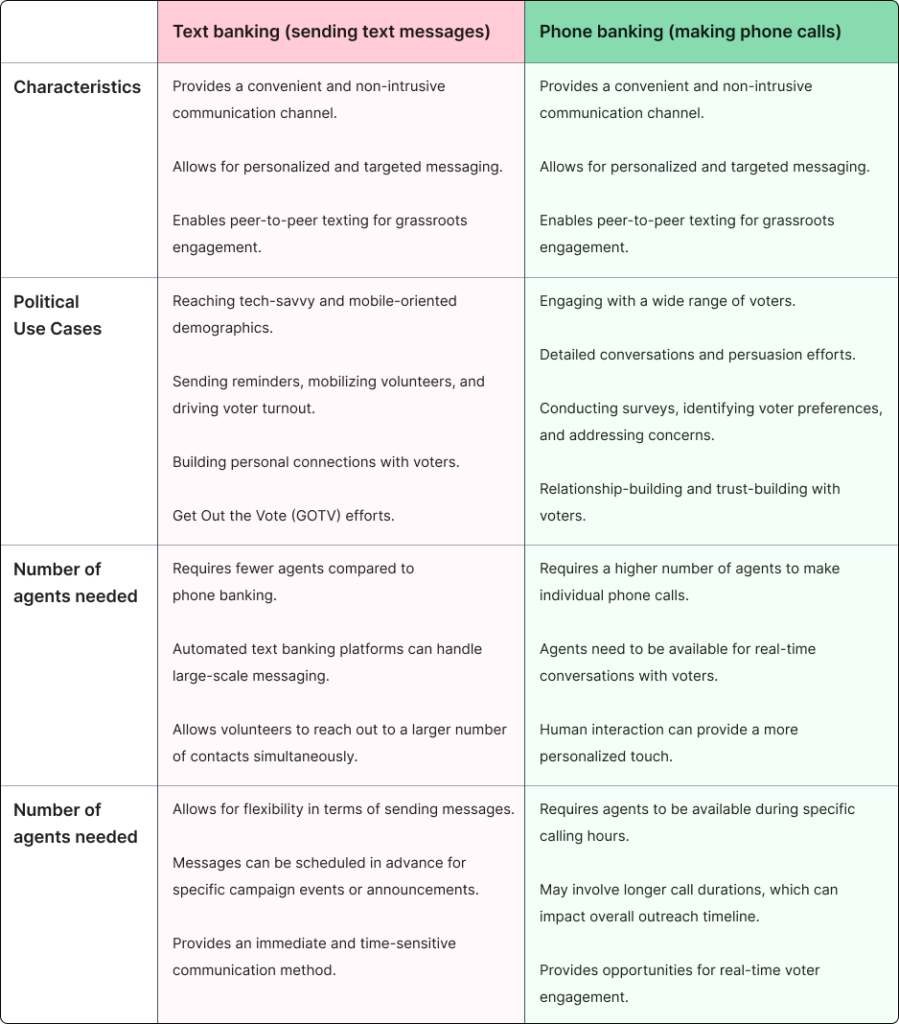
| Text banking (sending text messages) | Phone banking (making phone calls) | |
| Characteristics | Provides a convenient and non-intrusive communication channel. Allows for personalized and targeted messaging. Enables peer-to-peer texting for grassroots engagement. | Provides direct and interactive communication. Allows for real-time conversations, detailed explanations, discussions, and immediate feedback. Requires more agents. |
| Political use cases | Reaching tech-savvy and mobile-oriented demographics. Sending reminders, mobilizing volunteers, and driving voter turnout. Building personal connections with voters. Get Out the Vote (GOTV) efforts. | Engaging with a wide range of voters. Detailed conversations and persuasion efforts. Conducting surveys, identifying voter preferences, and addressing concerns. Relationship-building and trust-building with voters. |
| Number of agents needed | Requires fewer agents compared to phone banking. Automated text banking platforms can handle large-scale messaging. Allows volunteers to reach out to a larger number of contacts simultaneously. | Requires agents to be available during specific calling hours. It may involve longer call durations, which can impact the overall outreach timeline. Provides opportunities for real-time voter engagement. |
| Timeline | Allows for flexibility in terms of sending messages. Messages can be scheduled in advance for specific campaign events or announcements. Provides an immediate and time-sensitive communication method. | Requires agents to be available during specific calling hours. May involve longer call durations, which can impact overall outreach timeline. Provides opportunities for real-time voter engagement. |
Most campaigns use both channels — and they work better together. Text banking is often the faster option for reminders, rapid response, and volunteer-driven outreach, while phone banking fills the gaps where deeper conversation is needed.
How does text banking work?
A typical text banking strategy includes voter segmentation, message scripting, agent assignment, and response handling. Here’s how a campaign typically runs one end to end:
- Campaign managers create the strategy – defining goals, identifying target voter groups, writing message templates, and setting guidelines for agents.
- Agents log in to the text banking software and review campaign information. Messages go out according to a set schedule.
- Agents are assigned specific campaigns, often with contact lists segmented by demographics, geography, or other criteria.
- Agents handle responses – answering questions, providing additional information, or routing inquiries to the right contacts.
- Campaign managers set deadlines tied to key milestones like voter registration cutoffs or primary elections.
- Managers and agents stay in communication throughout to ensure messaging consistency and address challenges as they arise.
Throughout the campaign, campaign managers and agents maintain communication to address challenges, provide updates, and ensure consistency in messaging and campaign goals.
Who invests in text banking politics?
Text banking politics attracts campaign teams, nonprofit organizations, advocacy groups, and labor unions that need fast, scalable voter outreach. Here are a few examples:
State political parties activating young voters: The California Democratic Party organized virtual text banking events in collaboration with the California Young Democrats to activate young voters ahead of elections called “Text Young Voters Across California“..
Nonprofits gathering policy support: Brady, a gun safety organization, hosted text and phone banking events called “Brady Action Hour for Gun Safety!” to gather support for reintroducing the Assault Weapons Ban in the Senate.
Community defense campaigns: HRC in Arizona ran a “Defend the Community Textbank” event, reaching out to voters to counter legislative attacks on LGBTQ+ communities.
Voting rights advocacy: NextGen America organized text banking events focused on Michigan voters to ensure that voting rights approved by referendum were upheld by the legislature.
Statewide mobilization during legislative sessions: The Human Rights Campaign organized “Evenings of Action” in Louisiana to share news and resources with residents during an active legislative session.
How to start text banking politics?
If you’re building a text banking strategy for a political campaign, you’ll need voter data, trained volunteers, scripts, and compliant software. Here’s what each piece looks like in practice:
1. A list of voters to contact to begin text banking politics
Compile a list of mobile numbers for the voters you want to reach through text messages. This list can include registered voters, supporters, volunteers, or individuals within a specific target demographic.
Ensure the list is current and complies with applicable regulations and privacy policies. It must include mobile numbers to deliver text messages successfully.
Here are some tips on how to create a list of voters for text banking:
- Collect contact information from supporters, volunteers, and others interested in your campaign through online forms, phone calls, or in-person canvassing.
- Use a voter file to identify voters who are likely to be interested in your campaign. A voter file contains voters’ names, addresses, phone numbers, and voting history.
- Segment your list of voters. This will allow you to target your text messages to specific groups of voters.
- Clean your list of voters by removing those no longer eligible to vote or who have moved out of the area.
Read Also: Understanding List Segmentation: A Beginner-Friendly Guide
2. Volunteers to text bank
Your text bankers are the human face of your campaign in every conversation. Recruit people who are committed to the campaign’s goals and can communicate your message clearly and authentically. Train them before they start – consistency matters.
Read Also: How To Get Volunteers For Political Campaign: Step-By-Step Plan With Tips
3. A script for your text bankers
A good script gives volunteers a framework without making interactions feel robotic. In peer-to-peer (P2P) campaigns, the opening message is often standardized, but follow-up conversations should feel natural.
Scripts should include:
- A greeting and brief intro
- Your core message or ask
- A clear call to action
- Common follow-up responses for FAQs
Branching scripts – which adapt based on how the voter responds – tend to work best because they allow for more genuine two-way conversations.
4. A CRM to document voters’ responses and noteworthy information
Have a reliable CRM to record voters’ answers and important notes. Capturing information such as voter preferences, concerns, commitments, or any other relevant details enables personalized and targeted communication in future interactions.
Whether you’re using text banking or phone banking, this data serves as a valuable foundation for future outreach and follow-ups
5. A text banking software for text banking politics
Text banking software offers a range of features and functionalities to enhance the efficiency and effectiveness of your operations.
While phone banking offers a more direct, voice-based connection with voters, text banking enables rapid outreach to thousands of recipients at once—while still maintaining a personal tone.
Text banking software allows you to:
- Send mass text messages to many recipients simultaneously for text banking politics.
- Schedule messages to be sent at specific times, ensuring timely and targeted communication.
- Personalize messages by including variables such as recipients’ specific details.
- Track message delivery, open rates, and responses to gauge campaign performance.
- Manage opt-outs and handle unsubscribe requests automatically, ensuring compliance with regulations.
- Provide templates and tools to create and customize scripts for text bankers.
- Integrate with other systems or databases to synchronize and manage contact lists seamlessly.
- Facilitate two-way communication, enabling recipients to respond to messages and engage in conversations.
Resources for text banking politics
Here are some additional resources for text banking in politics:
- Building a voter list: Learn about government voter lists, vendors, and techniques like Text-to-Join to build your voter list.
- Volunteer recruitment: Discover strategies to attract and engage volunteers for your text banking campaign.
- Script examples: Explore script examples and guidance for effective text banking interactions. See how to craft compelling and persuasive messages tailored to your campaign.
- CRM solutions: Explore CRM systems to record and manage voter responses and important notes efficiently. Check out how these tools help you organize and analyze data for more effective campaign outreach across channels like text and phone banking.
Text banking politics guidelines
There are thee main guidelines to follow, during your text banking campaign for politics:
1. Follow all legal regulations
Make sure your campaign complies with FCC (Federal Communications Commission) regulations. This includes getting prior consent before texting voters and using approved 10DLC numbers if applicable.
📍 Also, double-check for any state-specific or local laws that may apply to political texting in your campaign’s area.
Read Also: 10DLC Registration: 2025 SMS Outreach Rules You Must Know
2. Use clear, easy-to-follow scripts
Your script should be simple enough for both volunteers to send and voters to understand. We highly recommend using a branching script because it allows for more natural, two-way conversations based on how the voter responds.
Example branching script:
“Hi [Voter Name], this is [Your Name] with [Campaign Name]. We’re reaching out to make sure everyone has the info they need for the upcoming election. Do you know where your polling place is, or would you like some help finding it?“
If the voter needs help:
“No problem! You can find your polling place here: [Link]. Let me know if you have any questions about voting hours or what to bring.“
If they’ve already voted:
“That’s awesome—thank you for making your voice heard! If you know anyone who still needs info, feel free to share this link.“
3. Provide volunteers with clear campaign guidelines
Consistency is key. Equip your volunteers with a simple checklist or code of conduct to follow while texting. This ensures every voter interaction reflects your campaign’s values, like:
- Always personalize texts by using the voter’s name
- Stay neutral and respectful—don’t argue or push back
- Log every response accurately for follow-up
- Flag anything unusual (hostile replies, wrong numbers, misinformation) to your campaign manager
Creating your first text banking campaign
Let’s delve into the details.
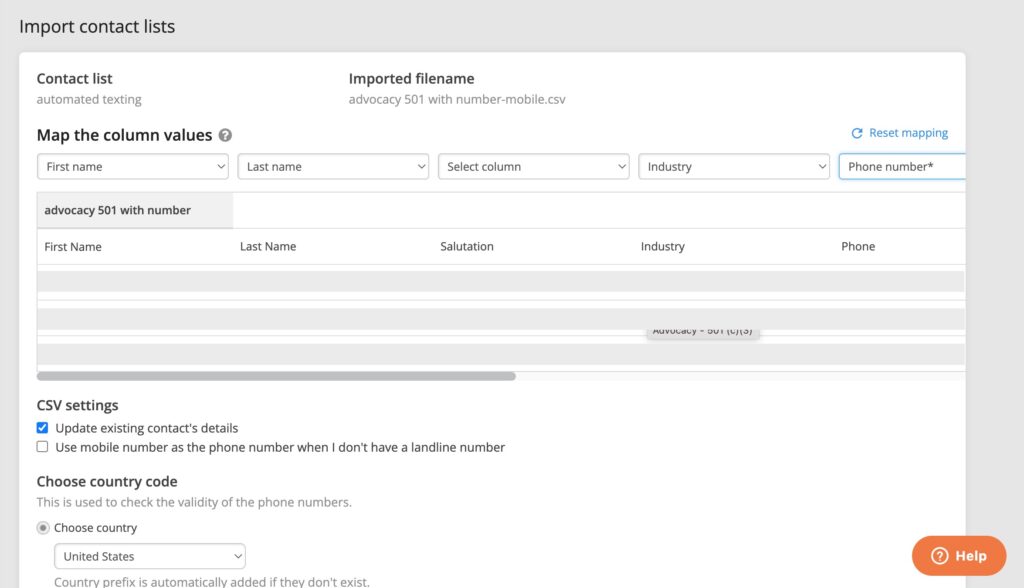
Create a contact list by importing a list of phone numbers from a CSV file or your CRM or manually adding them individually. To get step-by-step instructions, check out our blog on how to upload contacts.
This list can be used for both text and phone banking, depending on your campaign strategy.
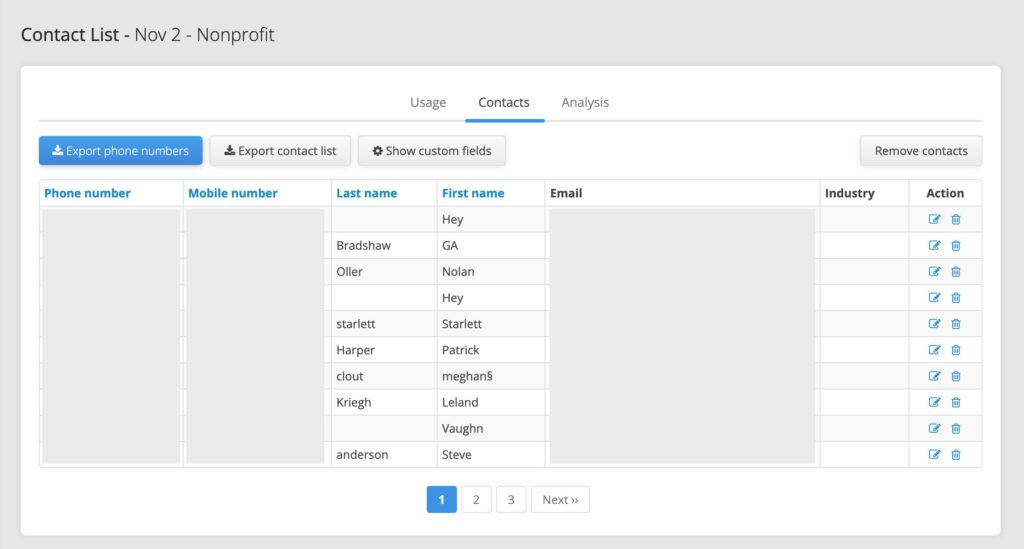
Important notes:
- Messages will only be sent to the phone numbers listed under the “Mobile Number” column.
- The “Phone Number” field is mandatory. If you have only one list of numbers, duplicate the column in your CSV file. Map one column with the required “Phone number” field and the other column with the “Mobile Number” field.
- Additional data can be mapped to default fields or custom fields.
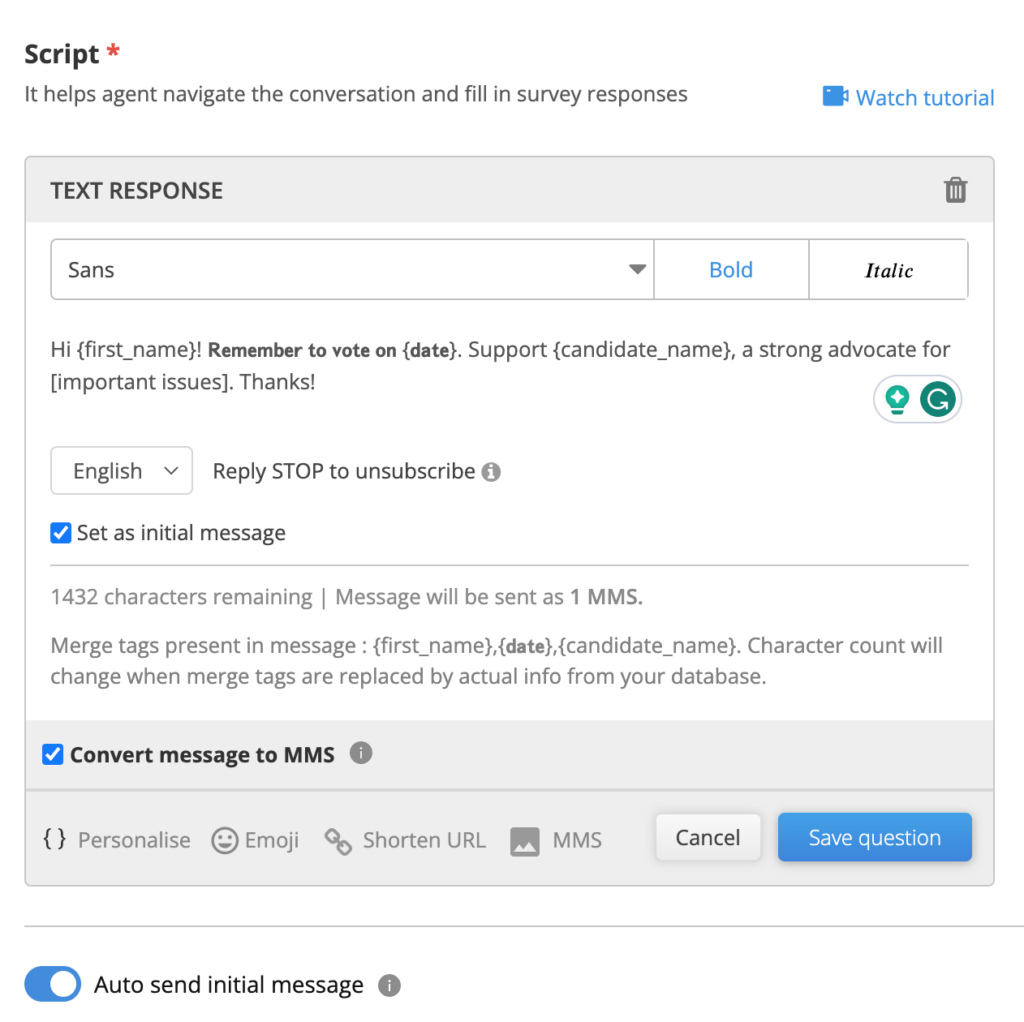
Create a short and to-the-point script. It should include a greeting, your message, and a call to action. Incorporate personalization elements, such as merge tags to insert relevant details.
You can find a list of available merge tags for your campaign by clicking on the ‘Merge tag’ option.
Important notes:
- A standard SMS can contain 160 ASCII characters or 70 Unicode characters. You will be charged for multiple SMS messages if you exceed this limit.
- You can use different font styles, such as bold or italics, and even include emojis to create a friendly and personalized experience for your recipients.
- To use font styling in your SMS campaigns, select the “Convert message to MMS” option to avoid multiple segment charges. Enabling this option will result in a single charge for an MMS. Incoming messages will be charged according to standard SMS and MMS rates.
- You can also include survey questions in your messages to collect data from your supporters and voters. The questions can be multiple-choice, text, or numeric.
- Set up saved replies to handle incoming messages efficiently. Your volunteers can select and send these pre-defined replies to provide quick responses to contacts.
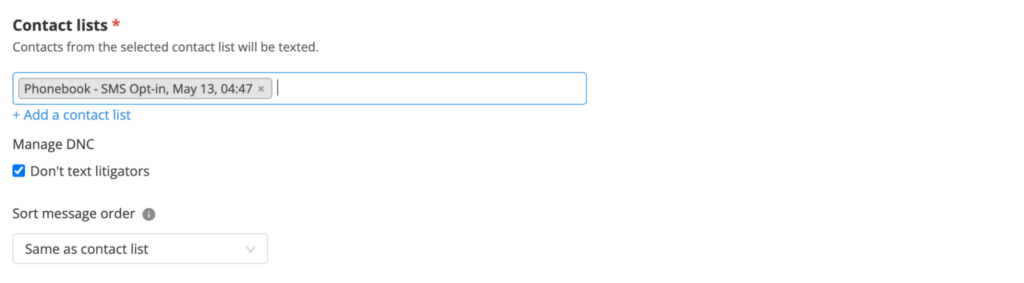
Connect the contact list(s) to your campaign.
Choose the number. CallHub offers different options based on your location:
For users in the USA:
- Rent a number automatically
- Existing numbers
- 10DLC numbers
- Adaptive Texting Block
For users outside the USA:
- Rent a number automatically
- Existing numbers
- Adaptive Texting Block
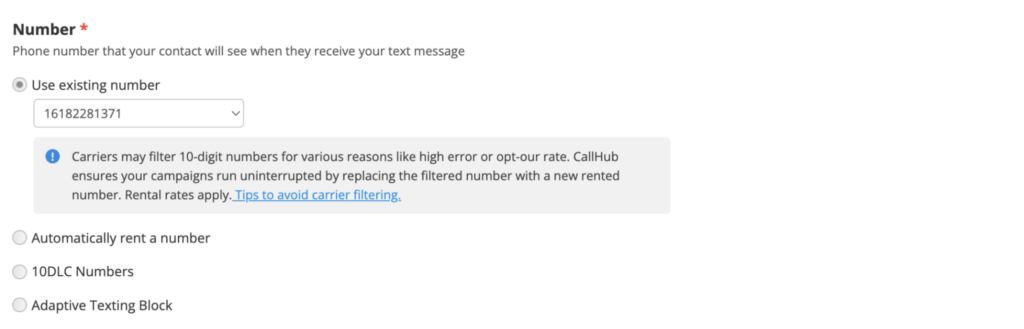
- Rent a number automatically: Choose the country you want to rent to send messages through your campaign.
- Existing numbers: If you already have phone numbers associated with your account, you can select one from the dropdown list to use as the sender ID for your campaign.
Note: If the rented number you wish to use does not appear in the dropdown list, you already have a campaign running with the same number. In such cases, stop the existing campaign to reuse the number for your current campaign. - 10DLC numbers: 10DLC numbers prevent carriers from blocking or filtering out your text messages.
- Adaptive Texting Block: The Adaptive Texting Block feature helps you configure your outreach rate, manage your local presence, and effectively handle rented sender IDs.
Assign agents to your campaign by inviting them to your CallHub account or by creating a campaign and then sharing the link with them. Once you have assigned agents, they can see the contact list, script, and status of the campaign.
You can add instructions for your agents to communicate your expectations for the current campaign.
To assign agents for the campaign, you have the following options:
- Assign all agents: This option automatically adds any newly created agent accounts to the campaign. If you haven’t created any agent accounts yet, choose this option.
- Select agents: With this option, you can manually choose specific agents to add to the campaign.
Note: You can also skip the agent assignment step for now and assign them later.

Initiate the text banking campaign. CallHub’s Fast P2P texting feature lets you send text messages to recipients simultaneously.
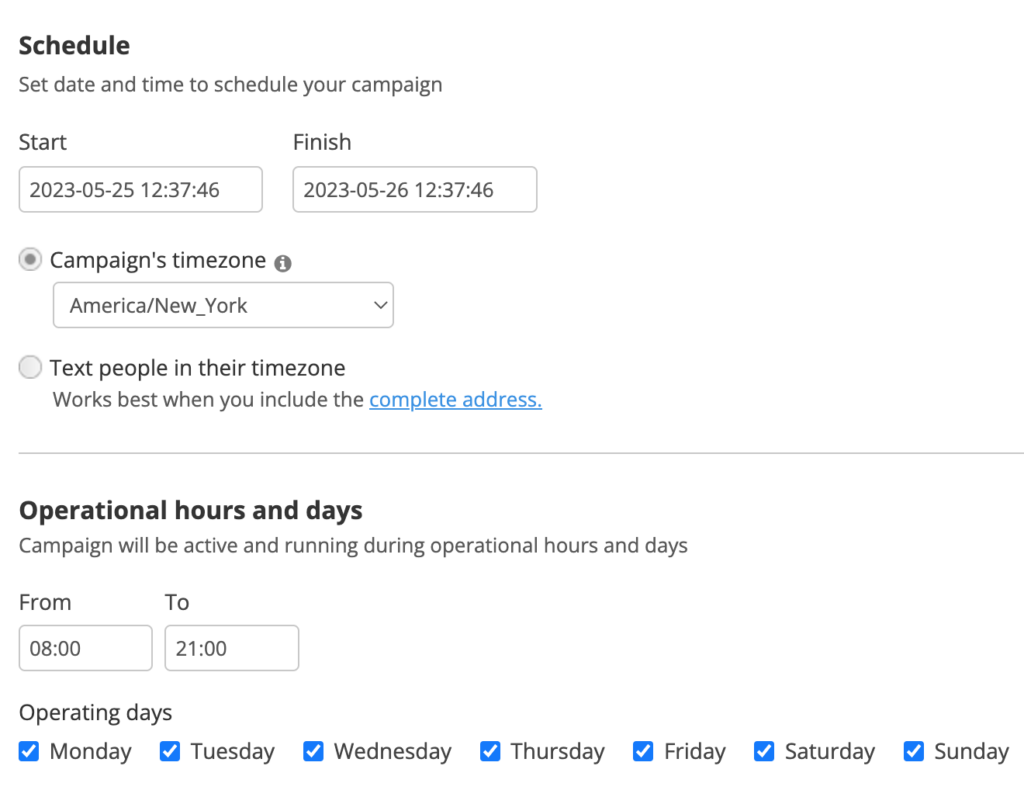
Specify your campaign’s start and end dates and select the operational hours for each day. The system will examine the contact list and filter out contacts classified as landlines or VoIP numbers.
According to a survey by McKinsey, data-driven organizations are 23 times more likely to acquire customers. Monitor the performance of your text banking campaign through CallHub’s analytics and reporting features. Track delivery rates, response rates, and other relevant metrics to assess the effectiveness of your campaign.
You can view the results in the Overview section and export the list by hovering over the “Filtered” section. Utilize this data to make informed decisions and refine your strategy as needed.

Advanced features for text banking for political campaigns
Text banking platforms have evolved well beyond simple mass messaging.
Here are the features that give serious campaigns an edge:
Auto-assign on P2P campaigns
Campaign organizers need to distribute contacts among volunteers efficiently. This can be time-consuming, create bottlenecks, and slow down the text banking process.
With CallHub, you no longer need to assign contacts to agents manually.
This feature enables volunteers to take ownership of text banking conversations by allowing them to auto-assign tasks based on their availability. This empowers volunteers to engage with voters at their own convenience actively.
When volunteers log in to the agent console and join the campaign, the system automatically assigns 100 contacts initially. Once the volunteer sends messages to these 100 contacts, the system will assign contacts in batches.
Relational organizing to boost text banking politics
The trust between campaigners and voters is limited when the voters don’t know who they interact with. The communication becomes generic and impersonal, leading to low response rates.
Relational organizing encourages volunteers to reach out to their own networks, leveraging existing connections to amplify your campaign’s messaging and mobilize support.
Tapping into the social capital of your volunteers expands your campaign’s reach and influence. It also fosters authentic conversations and increases the likelihood of engagement, as voters are more receptive to messages from people they know and trust. This is a novel way of using text banking politics.
This strengthens grassroots efforts and empowers supporters to become effective advocates for your campaign.
Read Also: Ultimate Relational Organizing Guide You Need in 2025
Mobile app for agents: text banking politics
Coordinating and managing volunteers can be a logistical challenge. Equip your volunteers with a dedicated mobile app that enables them to conduct text banking activities on the go.
With a mobile app, volunteers can join P2P text banking campaigns from their smartphones or tablets. This flexibility enhances their productivity and responsiveness, as they can participate in text banking efforts anytime, anywhere.
The mobile app also provides a user-friendly interface and real-time notifications, ensuring your volunteers stay connected and can actively contribute to your campaign.
In-built text-to-join tools
Traditional methods of opting in, such as web or paper forms, can be cumbersome and time-consuming for potential supporters. Also, when supporters opt-in through non-instantaneous methods, there can be delays in engaging them.
Text-to-join tools allow recipients to opt into your campaign by texting a designated keyword.
This functionality helps you capture contact information and grow your contact list. It eliminates the need for manual data entry and streamlines the onboarding process for new supporters. These tools also make it effortless for individuals to connect with your campaign.
Link tracker
You rely on persuasive messaging to engage recipients and motivate them to take action. However, you don’t know how many recipients are engaging with your messages and which links are being clicked.
Without evaluating the effectiveness of your text banking strategies, it’s hard to know if your communication is working and achieving its goals.
A link tracker helps you gain valuable insights into the effectiveness of your campaign messaging. It allows you to track the performance of shared links within your text messages.
The link tracker provides valuable data on recipient behavior, helping you understand which messages resonate the most with your audience. With this information, you can make data-driven decisions to enhance the effectiveness of your text banking campaign and drive higher voter engagement.
However, when you use external link trackers, carriers filter out your messages.
Opt for in-built link trackers that have a good reputation with carriers. These trackers often have measures to ensure your links are not flagged as spam or security threats.
Survey importing with political CRMs
Survey responses collected during text banking campaigns may be scattered across various platforms, spreadsheets, or manual records. This leads to data fragmentation, making it difficult to consolidate and analyze the data effectively.
Moreover, manually entering survey responses is time-consuming and can result in errors and inconsistencies.
Importing survey responses from popular political CRMs like NationBuilder, NGP VAN, and others streamlines your data management for text banking politics. These integrations gather survey data directly within your text banking platform, eliminating the need for manual data entry and ensuring data accuracy.
Importing survey responses also centralizes and consolidates valuable voter information, making it easier to segment and target specific groups for personalized outreach.
Must-have features for text banking for political campaigns
Here are some must-have features for text banking for political campaigns.
Message scheduling: text banking politics
Text banking politics campaigns require consistent and timely communication to maintain engagement with recipients, especially when communicating time-sensitive events, announcements, or important updates.
You may also target recipients across different time zones. Without message scheduling, it will be challenging to coordinate message delivery effectively to accommodate different time zones.
This feature lets you plan your text messages in advance and schedule them to be sent at specific dates and times. It ensures your campaign messages reach voters at the most optimal moments.
Automated account-level DNC list
Text banking campaigns must comply with regulations governing communication preferences and Do Not Contact requests. You need to stop sending texts to recipients who have opted out or requested not to receive further messages.
Failing to do so can result in inadvertent violations of regulations and potential legal consequences, including penalties of up to $1,500 per violation.
However, manually managing DNC requests can be time-consuming and prone to errors.
An automated account-level DNC list helps you stay compliant with these regulations. This feature automatically adds contacts to an account-level DNC list and skips them in your future campaigns.
Merge tags
In the average marketing campaign, irrelevant content leads to a significant decrease of 83% in response rates. However, manually personalizing each text message for individual recipients can be time-consuming and prone to errors, especially when dealing with a large number of recipients. It limits the scalability of the text banking campaign and hinders efficient outreach efforts.
To overcome this, personalize your text messages using CallHub’s merge tags. Merge tags are placeholders that can be dynamically replaced with recipient-specific information, such as their name, location, or other relevant details.
Saved response templates
Text banking organizers often encounter common questions or inquiries from multiple recipients simultaneously. Manually typing out responses each time can be time-consuming and prone to errors when organizers need to provide specific information or details.
Organizers may also struggle to maintain consistency in their communication.
Saved response templates are pre-written responses for common questions or interactions that frequently arise during your campaign. They let you quickly access and customize ready-made messages, saving time and ensuring consistency in your communication.
MMS texting
Traditional SMS texting relies solely on plain text messages, which may have a limited impact in capturing recipients’ attention or conveying complex information. Some messages, such as campaign posters, infographics, or charts, require visual information to communicate the message effectively.
Text messages alone may also struggle to evoke emotions effectively, especially when conveying sensitive or powerful messages. Also, traditional SMS text banking politics imposes character limits on messages, which can restrict the amount of information conveyed.
MMS (Multimedia Messaging Service) texting enhances your text banking campaigns by incorporating multimedia content. It lets you send images, videos, audio files, or other multimedia elements along with your text messages, creating more engaging and visually appealing communication.
Mobile number verification
Mobile number verification ensures the accuracy and validity of the phone numbers in your text banking campaigns. This verifies whether a phone number is active and reachable before sending messages.
This improves the delivery rate of your messages and increases the overall efficiency of your text banking politics efforts.
10DLC registrations
Carriers have specific rules and requirements for text message senders, including political organizations. Unregistered text messages from political organizations are likely to be blocked, filtered out, or flagged as spam by carriers, resulting in recipients not receiving your messages.
You will also have lower message throughput limits imposed by carriers, restricting the volume of messages sent within a given time frame.
10DLC (10-Digit Long Code) registrations ensure compliance with carrier regulations and optimize the deliverability of your text messages. This standard for sending commercial text messages helps improve message delivery rates and reduces the likelihood of messages being flagged as spam.
Failure to complete 10DLC registrations can lead to non-compliance, potentially resulting in account suspensions or legal issues.
Analytics and Reporting for text banking politics
Limited visibility into the performance and impact of text banking campaigns can make it challenging to
- Assess the effectiveness of messaging strategies, channels, timeframes,
- Identify areas of improvement and
- Make informed decisions to optimize campaign outcomes.
You may lack insights into recipient behavior and preferences. This can result in lower engagement rates and less impactful communication with the intended audience.
Analytics and reporting give you access to comprehensive data and analytics on your text banking campaign, including metrics such as message delivery rates, response rates, and engagement levels.
Integrations to help with text banking politics
Data fragmentation occurs when recipient information, campaign data, and messaging history are stored in different systems or databases.
This leads to multiple problems:
- It makes it difficult to have a comprehensive view of recipient interactions and campaign performance.
- It hinders effective decision-making and analysis and can lead to manual and time-consuming processes.
- Information scattered across multiple systems leads to miscommunication, duplicated efforts, and difficulty coordinating campaigns.
- It results in inaccurate or outdated recipient information that hinders text banking politics.
- Adding new tools, expanding recipient databases, or accommodating increased messaging volumes may require manual effort and customization.
Integration helps you connect your text banking platform with CRM systems used in political campaigns, enabling streamlined data management and synchronization between platforms.
Two-way communication: text banking politics
One-way communication, where recipients only receive messages without the ability to respond or provide feedback, can result in limited engagement.
Two-way communication enables recipients to respond to your text messages, fostering engagement and allowing for voter feedback, questions, and further conversations.
Compliance: text banking politics
Non-compliance with legal and regulatory requirements can lead to legal challenges, investigations, or administrative actions that disrupt normal campaign activities. It can damage an organization’s reputation and undermine public trust.
Compliance tools help you comply with legal requirements, such as TCPA regulations and other relevant laws governing text banking politics.
Read Also: The Ultimate TCPA Compliance Checklist to Avoid Massive Fines
Take your political campaign to new heights with text banking politics
In today’s fast-paced political landscape, staying ahead is crucial. Text banking politics can transform political campaigns and ignite meaningful connections with voters.
Learn more about how CallHub can supercharge your political campaign through peer-to-peer texting.
Featured image: Photo by George Dolgikh
Frequently asked questions on text banking politics
What is text banking in politics?
Text banking in politics is the use of SMS or peer-to-peer (P2P) texting by campaigns to reach voters, share updates, mobilize supporters, and increase turnout.
Is political text banking safe and legal?
Yes—when done with voter consent, compliance with TCPA/FCC rules, and proper opt-out options. Campaigns also need 10DLC registration for deliverability.
How can volunteers get involved in text banking?
Volunteers can sign up with campaign organizations, receive scripts and training, and use campaign texting platforms to send messages to targeted voter lists.
Does text banking really work for elections?
Yes, studies show it can increase voter turnout by around 3%. Campaigns like Obama, Sanders, and Clinton have successfully used texting to fundraise, mobilize, and inform supporters.
What’s the difference between text banking and phone banking in politics?
In easy terms:
Most campaigns use both together.
Text banking = fast, scalable, less intrusive, better for GOTV and reminders.
Phone banking = deeper conversations, persuasion, and relationship-building.